Activities

Events

Badge Seminari di Dodis

Résumer des documents diplomatiques avec l’IA: promesses et limites actuelles

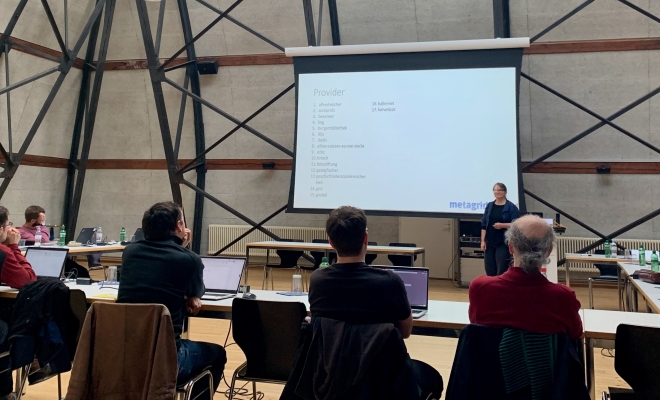
Cette présentation s’inscrit dans le cadre du projet «AI-Supported Human-Computer Interaction with Large Volumes of Historical Documents» visant à concevoir des algorithmes capables de soutenir les processus éditoriaux de Documents diplomatiques suisses. Elle se concentre sur un cas d’usage précis: la génération automatique de résumés de documents historiques, envisagée comme un outil d’assistance à la sélection et à l’exploration des sources au sein du flux de travail éditorial. Sur la base de premières expérimentations, Xavier Baume met en évidence une tension récurrente: malgré leur caractère génératif, les modèles de résumé produisent fréquemment des textes qui réutilisent des segments du document source, parfois de manière substantielle. Ce constat invite à reconsidérer l’opposition classique entre résumés dits «abstractifs» et «extractifs», telle qu’elle structure généralement la recherche en traitement du langage naturel.Au-delà des analyses portant sur les sorties des modèles, ces observations mettent en lumière un enjeu plus fondamental: le statut des données mobilisées pour l’entraînement et l’évaluation des systèmes. Les résumés existants ne constituent ni une référence stable ni un ensemble homogène; ils relèvent de cadres éditoriaux historiquement situés, dont les conventions interprétatives et formelles ont évolué dans le temps. Les traiter comme référence (ou ground truth) suppose donc d’interroger les conditions de leur production au sein même du projet éditorial.
read more
Badge Vernissage DDS 1995

Diplomatic Documents of Switzerland 1995

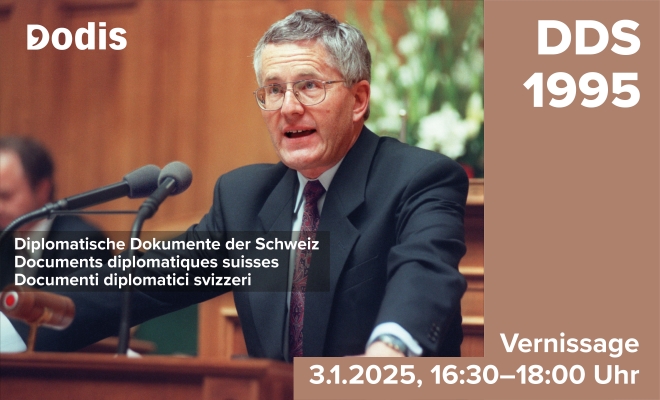
On 3 January 2026, Dodis celebrated the publication of the Diplomatic Documents of Switzerland DDS 1995 with numerous Amiche e Amici di Dodis. Prof. em. Dr. Madeleine Herren-Oesch, President of the Dodis Commission, welcomed them at the University of Bern. Prof. Dr. Sacha Zala, Director of Dodis, then presented the new volume of Diplomatic Documents of Switzerland and gave an impressive overview of the foreign policy issues that came to the fore from 1995 onwards and would continue to shape Swiss foreign policy from then on. Christa Gall (SRF Federal Parliament correspondent) echoed the Dodis director’s explanations in her interview with the evening’s guest of honour, former Federal Chancellor Walter Thurnherr. As a young diplomat in Moscow in 1995, Thurnherr was at the heart of events and provided a lively insight into the practical work of Swiss crisis diplomacy.Watch the entire vernissage on 3 January 2026:  The commemorations marking the end of the Second World War force the Federal Council to take a stance on Switzerland’s treatment of Jewish refugees during the Nazi era. Issues related to asylum and migration also feature prominently in day-to-day political activity. In preparation for Switzerland’s OSCE chairmanship, the diplomatic service is engaged in conflict prevention in crisis areas of the post-Soviet states and in the former Yugoslavia. The free movement of persons and the transport dossier remain key sticking points in bilateral negotiations with the EU. The edited documents also address human rights and environmental policy, development cooperation and economic relations with Asia, Latin America and North Africa.Direct access to the volume DDS 1995To the press release Programme for the vernissageBegrüssung durchProf. em. Dr. Madeleine Herren, Präsidentin der Dodis-KommissionProf. Dr. Sacha Zala, Direttore DodisPresentazione del nuovo volumeWalter Thurnherr, alt Bundeskanzlerim Gespräch mitChrista Gall, Bundeshaus-Korrespondentin SRFApéroFlyer
read more
Badge Seminari di Dodis

27.10.2025:  L’aide suisse en cas de catastrophes à l’étranger, 1875–1982

Le 27 octobre 2025, Donia Hasler a présenté ses recherches sur l’aide humanitaires suisse dispensée en cas de catastrophes survenues à l’étranger.L’implication de la Confédération dans les secours de catastrophes d’origine naturelle débute en 1875 après que des inondations plongent la population du sud de la France dans une grande détresse. Dans la volonté de manifester son soutien, les autorités helvétiques versent au gouvernement français une large contribution financière et organisent une collecte de dons auprès de la population suisse. Cette première expérience sera répétée en faveur de l’Italie, des Etats-Unis et du Japon dans les décennies suivantes. Durant l’entre-deux-guerres, le rapport de la Confédération aux secours de catastrophe évolue puisque le gouvernement se contente dès lors de soutenir les initiatives qui émanent d’organisations privées suisses. Ainsi, l’Etat fédéral verse de nombreuses contributions à la Croix-Rouge suisse qui mène des projets de reconstruction en Hollande, Grèce, Algérie, au Maroc, au Chili et en Yougoslavie. Une nouvelle stratégie est adoptée en 1972 avec la création du Corps d’aide suisse en cas de catastrophes naturelles, une organisation de volontaires financée exclusivement par le budget du Département politique et fédéral, qui participe à la reconstruction des zones sinistrées et aux opérations de sauvetage.L’analyse des interventions de la Confédération sur le long terme met en avant la grande diversité du répertoire d’actions qui est le produit des évolutions de la politiques étrangère et commerciale menée par les autorités fédérales. Parcourir un siècle de secours de catastrophes permet ainsi d’illustrer la multitude d’enjeux extra-humanitaires qui façonnent les démonstrations de solidarité de la Confédération.Flyer
read more
QdD24_Flyer

3.3.2025: Vernissage Quaderni di Dodis – memorie

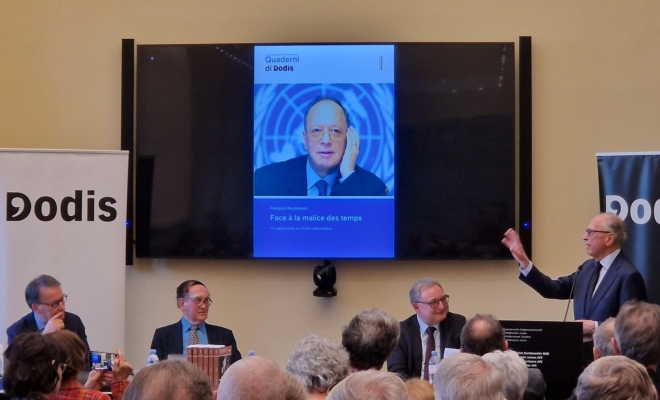
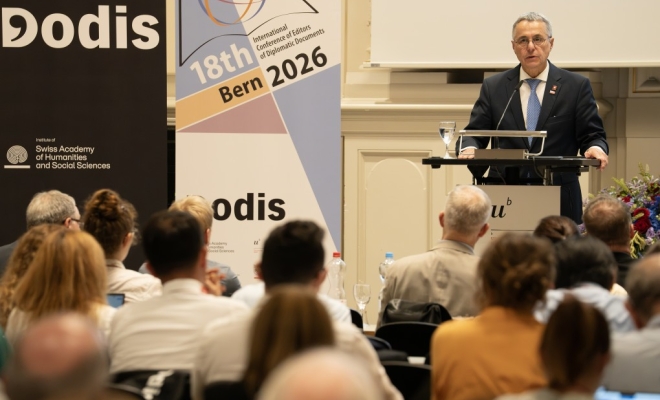
Diplomate et ambassadeur, François Nordmann s’est engagé toute sa vie pour défendre la place de la Suisse dans les instances multilatérales. Le 3 mars 2025, exactement 23 ans après le oui du peuple à l’adhésion de la Suisse à l’ONU, il a présenté ses mémoires intitulées «Face à la malice des temps. Un regard lucide sur l’action diplomatique».Ce volume de la série Quaderni di Dodis – memorie, la série consacrée à la publication de témoignages, donne un aperçu d’une carrière qui a débuté de façon peu commune. En effet, le juriste fribourgeois, très attaché à sa ville, devient rapidement conseiller communal tout en occupant le poste de collaborateur diplomatique du Chef du Département politique fédéral, à l’époque le Conseiller fédéral Pierre Graber. Propulsé au cœur de la politique étrangère suisse, le jeune diplomate Nordmann va faire ses premières armes à l’étranger en 1980, à la Mission suisse à New York, puis dans son premier poste d’ambassadeur en Amérique centrale, à Guatemala-City, avant de revenir en Europe, à l’UNESCO à Paris. Sa carrière se place donc très tôt sous le signe du multilatéralisme, ce que confirment ses affectations suivantes, qui le destinent également à diriger d’importantes missions bilatérales. Il prend la tête de la Direction des organisations internationales en 1992, puis devient ambassadeur au Royaume-Uni, à l’ONU à Genève et enfin encore à Paris, à l’ambassade cette fois.Ensemble, nous avons fêté le vernissage du livre le 3 mars 2025 aux Archives fédérales à Berne. Flyer ProgrammeBienvenueSacha ZalaMémoires d’ambassadeur et analyses historiquesMarc PerrenoudTémoignage d’un amiAntoine FleuryLa parole à l’auteurAmbassadeur François NordmannApéro
read more
Badge DDS 1994

Diplomatic Documents of Switzerland 1994

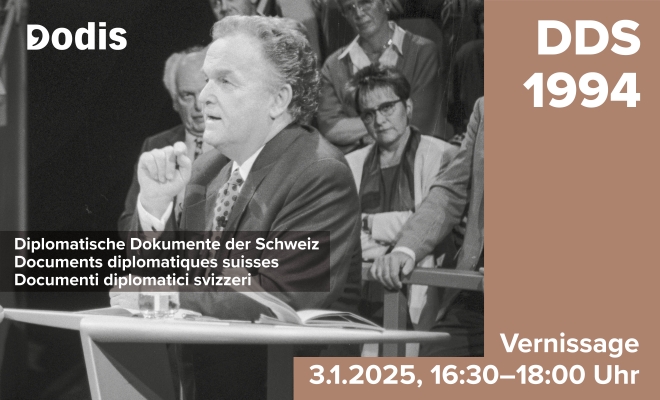
On 3 January 2025, Dodis celebrated the publication of the Diplomatic Documents of Switzerland DDS 1994 at the University of Bern. Prof. em. Dr. Madeleine Herren-Oesch, President of the Dodis Commission, welcomed the many Amiche e Amici di Dodis who had gathered for the occasion. Prof. Dr. Sacha Zala, Director of Dodis, then presented the new volume of Diplomatic Documents of Switzerland, impressively illustrating how closely Switzerland’s domestic and foreign policies are intertwined. Valérie de Graffenried (Le Temps) echoed the Dodis director’s explanations in her interview with the evening’s guest of honour, former Federal Councillor Ruth Dreifuss. The Minister of the Interior from 1993 to 2002 gave the audience an in-depth insight into the events of 1994.Photo: Karl-Heinz HugWatch the entire vernissage on 3 January 2025:  Swiss foreign policy must also negotiate with the people. The President of the Confederation, Otto Stich, was well aware of this when he spoke on the Swiss television programme «Arena» on 16 September 1994 in defence of the law against racism, which had been submitted to a referendum. Earlier in the year, the Federal Council had suffered painful defeats over the direction of its international policy, with the acceptance of the Alpine initiative in February and the rejection of the federal law on Swiss troops for peacekeeping operations (blue helmets) in June. While the Federal Council successfully won the vote on 25 September on Switzerland’s accession to the UN Convention against Racism, 1994 nevertheless provided a striking demonstration of the extent to which its foreign policy could be subject to opposing winds – and the extent to which Switzerland’s domestic and foreign policies are closely intertwined.This interconnection is also apparent in the many other issues that shaped Switzerland’s international relations in 1994: in negotiations with the EU on sectoral bilateral agreements, in environmental and energy policy, and in dealing with the Parliament and the cantons, which wished to play a greater part in shaping foreign policy. All these elements are featured in the Diplomatic Documents of Switzerland 1994, which the Dodis research centre will publish on 1 January 2025.Direct access to the volume DDS 1994To the press release Programm for the vernissage on 3 January 2025Begrüssung durchProf. em. Dr. Madeleine Herren, Präsidentin der Kommission DodisProf. Dr. Sacha Zala, Direttore DodisPresentazione del nuovo volumeConseillère fédérale Ruth DreifussEntretien avecValérie de Graffenried, Le TempsApéroFlyer
read more
logo

27.5.2024: Diplomatie universitaire et formation des élites à Genève

Le 27 mai 2024, Charlotte Roy a présenté les résultats de sa recherche de doctorat sur l’histoire de l’IUHEI et de son directeur Jacques Freymond. À la sortie de la Seconde guerre mondiale, l’Institut universitaire de hautes études internationales fondé en 1927 (actuel Graduate Institute Geneva),  vit une période de redéfinition de sa mission. C'est dans ce contexte qu’un nouveau directeur est nommé à la tête de l’IUHEI. Le professeur d’histoire lausannois Jacques Freymond entame son mandat avec de nouveaux projets pour l’Institut et commence à réinventer sa mission. Très vite les grandes fondations philanthropiques américaines Ford et Rockefeller apportent leur soutien financier. Le Département politique fédéral – qui administre l’Institut du fait de sa forte dimension internationale – augmente lui aussi sa contribution. Mais quel type d’innovations Jacques Freymond promet-il à ses bailleurs pour les convaincre de soutenir l’Institut? En pleine guerre froide, les philanthropes américains poursuivent leur politique d’influence à travers l’éducation. Les financements qu’ils apportent aux universités doivent servir à lutter contre le communisme, à promouvoir l’internationalisme libéral et à renforcer l’hégémonie américaine sur le monde. La Suisse, quant à elle, cherche à sortir de l’isolement diplomatique, à revaloriser la neutralité et à montrer son utilité à la communauté internationale en développant notamment tout un dispositif de diplomatie culturelle. La thèse de doctorat de Charlotte Roy soulève des questions à l’intersection entre l’histoire globale et locale, politique et académique. Flyer
read more
Badge Seminari di Dodis

11.3.2024: Im Alpenrosenfrack in die Weltpolitik

Am 11. März stellte der Historiker Julian Wettengel die Ergebnisse seiner Dissertation «Im Alpenrosenfrack in die Weltpolitik. Diplomatische und politische Funktionen von schweizerischen Händlern in Ost- und Südostasien 1857–1945» vor, welche im Rahmen des SNF-Projekts «A Global History of Swiss Diplomacy» am Europainstitut der Universität Basel entstanden ist. Schweizerische Händler etablierten sich ab Mitte des 19. Jahrhunderts in verschiedenen Regionen Ost- und Südostasiens. Nebst ihren geschäftlichen Aktivitäten übten sie auch verschiedene diplomatische und politische Funktionen vor Ort, zum Teil aber auch in der Schweiz aus. So waren schweizerische Kaufleute als Lobbyisten, Kolonialverwalter sowie als Honorarkonsuln für die Schweiz und für verschiedene Drittstaaten tätig. In Kriegs- und Krisenzeiten engagierten sie sich zudem im Feld der humanitären Diplomatie und der «Guten Dienste». So fungierten sie beispielsweise während des Zweiten Weltkriegs als Delegierte des Internationalen Komitees vom Roten Kreuz (IKRK) und betreuten vor Ort die Schutzmachtmandate der Schweiz. Wettengels Studie zeigt die Verbindungen zwischen den diplomatisch-politischen und geschäftlichen Funktionen der Kaufleute und damit auch die wechselseitigen Abhängigkeiten und Beziehungsmuster zwischen staatlichen und privatwirtschaftlichen Akteuren. So können einerseits die Motive und Strategien von Händlern zur Übernahme von diplomatisch-politischen Funktionen, andererseits aber auch die Vorteile für Staaten bezüglich einer Kooperation mit Kaufleuten sichtbar gemacht werden. Im Zentrum steht die Frage, welche Rolle Händler in den internationalen Beziehungen und für die schweizerische Aussenpolitik spielten. Julian Wettengel stellt seine Dissertation vor.
read more
NNSC

70 Jahre Neutral Nations Supervisory Commission (NNSC)

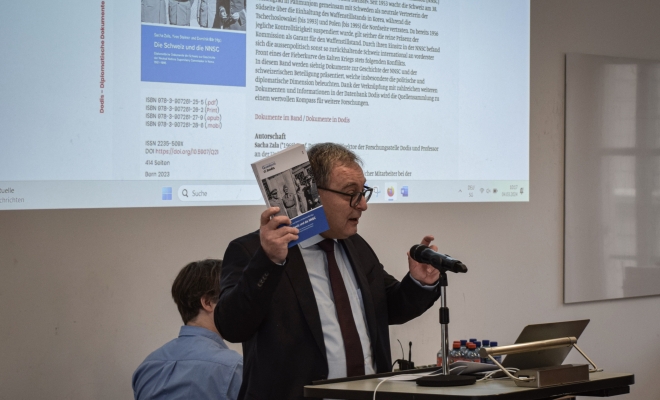
Seit 1953 ist die Schweiz Mitglied der Neutral Nations Supervisory Commission (NNSC) in Korea. Aus Anlass des 70-jährigen Jubiläums hat die Forschungsstelle Dodis die Geschichte dieser ersten militärischen Friedensförderungsmission der Schweiz erforscht und unter dem Titel «Die Schweiz und die NNSC» einen Band der Open Access Reihe Quaderni di Dodis publiziert. An einer gemeinsam mit swisspeace organisierten Veranstaltung an der Universität Bern wurde die Publikation am 4. März 2024 einem breiteren Publikum vorgestellt. Unter Anwesenheit der Vorsteherin des VBS, Bundespräsidentin Viola Amherd, diskutierten Vertreterinnen aus der Wissenschaft, Diplomaten, ehemalige NNSC-Mitglieder und Sicherheitspolitikerinnen die Lehren, die aus dem schweizerischen Engagement bei der NNSC für die aktuelle und künftige militärische Friedensförderung der Schweiz gezogen werden können. Programm: Begrüssung Viola Amherd (Bundespräsidentin, Chefin VBS) Rückblick auf 70 Jahre NNSC und Schweizer Beteiligung Sacha Zala (Direktor Dodis, Professor für Geschichte Universität Bern) Heutiger Blick auf den Schweizer Beitrag Joachim Adler (Chef Verteidigungspolitik und nationale Koordination, Staatssekretariat für Sicherheitspolitik SEPOS, VBS) Peter Semneby (Botschafter, Sonderbeauftragter Schwedens für die Koreanische Halbinsel) Podium / Diskussion Marianne Binder-Keller (Ständerätin, Die Mitte) Franziska Roth (Ständerätin, SP) Urs Gerber (ehemaliger Chef der Schweizer NNSC-Delegation) Sara Hellmüller (Senior Researcher, CSS/ETHZ) Moderation: Laurent Goetschel (Direktor swisspeace, Professor für Politikwissenschaft Universität Basel) Bundespräsidentin Viola Amherd begrüsst die Anwesenden Die Ständerätinnen Marianne Binder Keller und Franziska Roth (v.l.n.r.) diskutieren zusammen mit dem Direktor von swisspeace Prof. Dr. Laurent Goetschel, dem ehemaligen Chef der Schweizer NNSC-Delegation Dr. Urs Gerber und der Wissenschaftlerin Dr. Sara Hellmüller am Podium die Lehren aus dem schweizerischen Engagement bei der NNSC. Dr. Joachim Adler (Chef Verteidigungspolitik und nationale Koordination – VBS) referiert zur militärischen Friedensförderung. Botschafter Peter Semneby (Sonderbeauftragter Schwedens für die Koreanische Halbinsel) erläutert die schwedische Position und das Engagement Schwedens bei der NNSC.
read more
Vernissage DDS 1993

Diplomatic Documents of Switzerland 1993

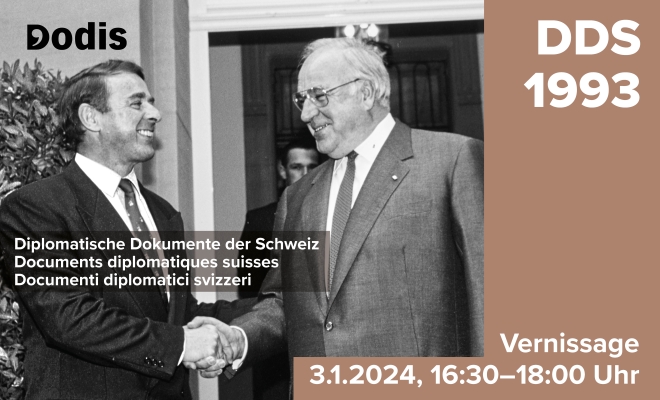
On 3 January 2024, Dodis celebrated the publication of Swiss Diplomatic Documents DDS 1993 at the University of Bern. Prof. Dr. Virginia Richter, Rector designate of the University of Bern, and Prof. em. Dr. Madeleine Herren-Oesch, President of the Dodis Commission, welcomed the many Amiche e Amici di Dodis who had gathered for the occasion. Prof. Dr. Sacha Zala, Director of Dodis, then presented the new volume of Swiss Diplomatic Documents and gave an impressive illustration of how the Confederation launched a veritable «charm offensive» after the rejection of the EEA on 6 December 1992. Marc Tribelhorn (NZZ) echoed the explanations of the Dodis director in his interview with the evening's guest of honour, former Federal Councillor Adolf Ogi. The President of the Confederation for 1993 offered an in-depth overview of the events that marked his first year as President.   Watch the entire vernissage on 3 January 2024 :   Following the rejection of the EEA, the Federal Council set about establishing sectoral bilateral negotiations with the EU by launching a visiting offensive. In its report on Swiss foreign policy in the 1990s, it outlined a global strategy for defending Switzerland's interests in a changing international context. Other topics covered in the published documents include economic relations with Asia, development cooperation, cooperation with Eastern Europe, security policy issues, international environmental policy, the wars in Yugoslavia and immigration and asylum policy.  To the detailed press release Direct access to the volume DDS 1993   Programme for the vernissage on 3 January 2024 Begrüssung Prof. Dr. Virginia Richter, designierte Rektorin der Universität Bern Prof. em. Dr. Madeleine Herren, Präsidentin der Kommission Dodis Prof. Dr. Sacha Zala, Direttore Dodis Presentazione del nuovo volume alt Bundespräsident Adolf Ogi im Gespräch mit Marc Tribelhorn (NZZ) Flyer  
read more
Badge Seminari di Dodis

4.12.2023: Vom Politischen zum Auswärtigen. Eine prosopografische Verwaltungsgeschichte der Schweizer Diplomatie

Am 4. Dezember präsentierte Dr. Dominik Matter die Ergebnisse seiner in der Reihe «Quaderni di Dodis» veröffentlichten Dissertation. Dabei stehen auch die in Kooperation mit Dodis erfassten und in der Datenbank Dodis veröffentlichten biografischen Daten von beinahe 2000 schweizerischen Diplomaten und Diplomatinnen im Fokus. Die Formel «vom Politischen zum Auswärtigen» steht nicht nur für die Umbenennung des schweizerischen Aussenministeriums, sondern sinnbildlich für einen vielschichtigen Reorganisationsprozess, der sich zwischen 1945 und 1979 vollzogen hat. Der spätestens mit der Gründung des Völkerbunds einsetzende Strukturwandel der internationalen Beziehungen erforderte eine Anpassung des schweizerischen diplomatischen Diensts. Der Zweite Weltkrieg und die Übernahme zahlreicher Vertretungsmandate fungierten als entscheidende Katalysatoren für diese Modernisierung und führten zu einer Professionalisierung, Diversifizierung und Vergrösserung des diplomatischen Personals. Dominik Matters Studie zeigt in paradigmatischer Weise die Wechselwirkungen zwischen staatlicher Verwaltung, internationalen Entwicklungen und transnationalen Prozessen auf. Der prosopografische und verwaltungsgeschichtliche Fokus eröffnet Einblicke in die unterschiedlichen Ebenen und Ausprägungen der schweizerischen Aussenpolitik. Dadurch zeigt die Analyse den Umgang der Bundesverwaltung mit den Herausforderungen einer globalisierten Welt, internationaler und multilateraler Kooperation, Dekolonisierungsprozessen, der europäischen Integration sowie innenpolitischen und zivilgesellschaftlichen Forderungen. Dominik Matter stellt seine Dissertation vor.
read more