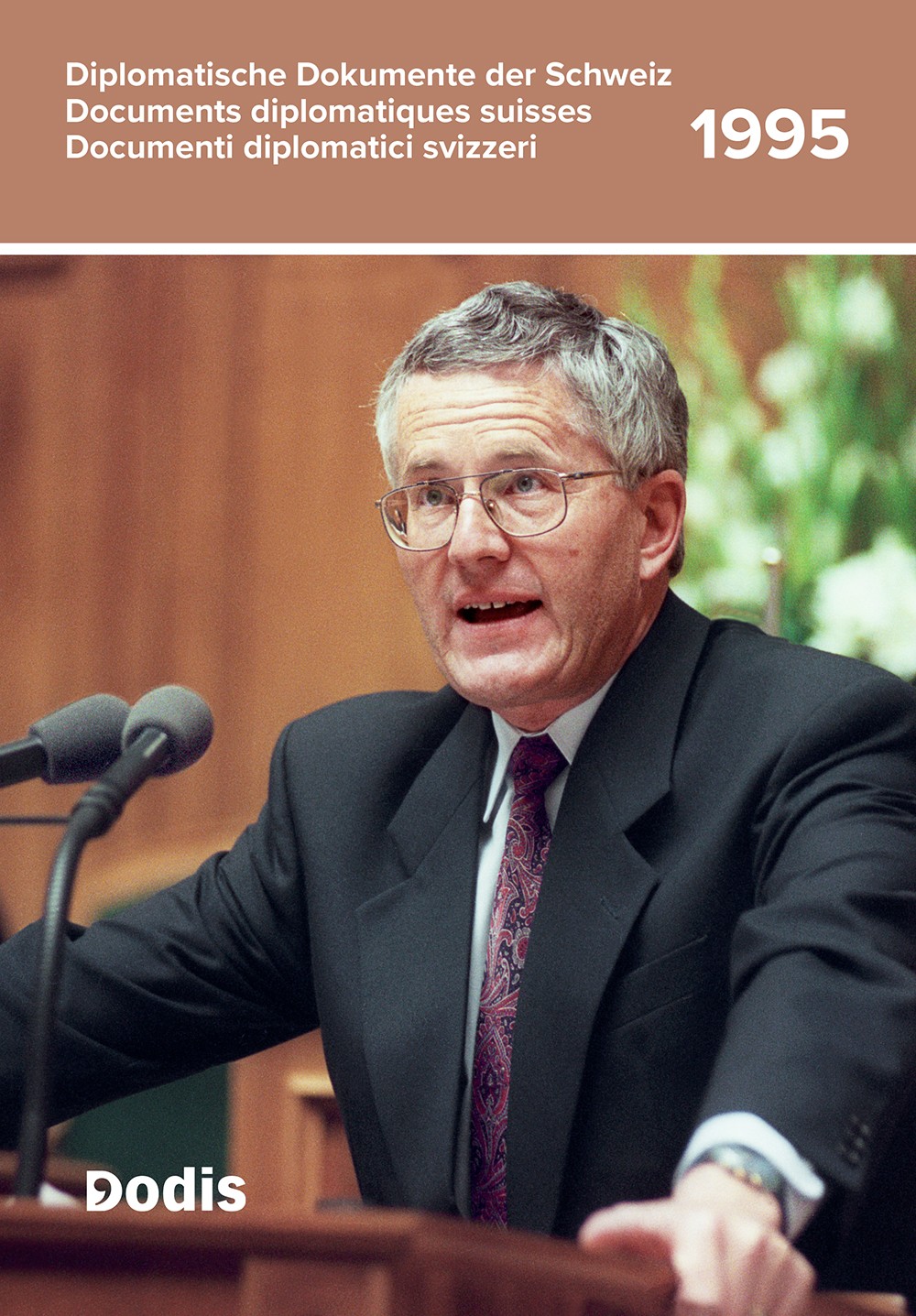
Right on time for the start of the new year, the Dodis research centre is presenting its research on Switzerland’s international relations in 1995. From hundreds of meters of files stored in the Swiss Federal Archives, Dodis has selected a number of key documents and will publish them on 1st January 2026 – precisely when their legal protection period expires.
«The commemorative year marking 50 years since the end of the Second World War not only prompted Switzerland to engage more deeply with its own past, but also laid the groundwork for several future core themes of its foreign policy», explains Sacha Zala, Director of Dodis. Beyond the issue of asylum seekers, attention focused on preparations for Switzerland’s chairmanship of the Organisation for Security and Cooperation in Europe (OSCE) in 1996, the unblocking of bilateral negotiations with the EU, and engagement with the emerging economic powers of Latin America and Asia.
A historic moment
In his speech on 7 May 1995 at the special session commemorating the 50th anniversary of the end of the Second World War in Europe, President Kaspar Villiger spoke with unusual clarity. He stated that there was, in his view, «no doubt that we have incurred guilt through our policy towards the persecuted Jews». He added that «the Federal Council deeply regrets this and apologises for it, knowing that such failure is ultimately inexcusable» (dodis.ch/70433). This was the first occasion on which official Switzerland apologised for the shortcomings of its refugee policy during the Nazi era – in carefully chosen words, as the minutes of the Federal Council meeting of 3 May 1995 make clear (dodis.ch/70371). In a year in which immigration and asylum were matters of particular concern to the federal administration, the Federal Council’s conference call on 7 August on the admission of additional war refugees from the former Yugoslavia stood in sharp contrast to the admission of guilt regarding refugee policy during the Second World War. It was argued that Switzerland should not «push ahead» and therby provide right-wing extremist groups with «campaign ammunition». Ultimately the Federal Council agreed on the vague formulation that «the admission of an appropriate number of persons» would be guaranteed once the total number of displaced persons to be admitted had been determined (dodis.ch/70374).
Security in Europe
The escalating situation in Yugoslavia continued to occupy the OSCE in 1995. Following the peace agreement concluded in November 1995, it became clear that the OSCE would be involved, to an unprecedented degree, in shaping the post-war order in Bosnia and Herzegovina (dodis.ch/70173). Implementing the Dayton Agreement therefore became one of the main tasks of Switzerland’s OSCE Presidency in 1996. Closely linked to this was the broader question of the future of European security cooperation and the respective roles of NATO, the OSCE, the United States and Russia. According to Federal Councillor Cotti, the aim of the envisaged security model was to «prevent Russia’s exclusion» and to secure the former hegemonic power a place «within the European security architecture» commensurate with its importance (dodis.ch/62659). This approach also encompassed preventive diplomacy in the successor states of the Soviet Union: various Swiss nationals were deployed on OSCE missions not only in Sarajevo and Macedonia, but also in Ukraine, Moldova and Chechnya (dodis.ch/71507).
Integration despite headwinds
Bilateral negotiations with the European Union remained the Federal Council’s most important dossier. Considerable progress had already been made in the areas of technical barriers to trade, research and agriculture, but talks had stalled over the key issues of land and air transport and the free movement of persons. As Swiss chief negotiator State Secretary Kellenberger noted in October, «the Commission remains at the negotiating table, but continues to adhere strictly to the guidelines set out in its mandates. Its scope for contributions to the resolution of politically sensitive issues is therefore very limited» (dodis.ch/71254). Public opinion also remained sceptical of integration. Following the failed vote on easing legislation restricting the purchase of real estate by foreigners, the Federal Council reacted with dismayed: the electorate jeopardises the negotiations on the free movement of persons (Delamuraz), the outcome was discribed as a «catastrophe» (Dreifuss) and Switzerland now faced the risk of a «comprehensive blockade in its German-speaking regions against any further opening to the outside world» (Koller) (dodis.ch/71762).
Economic relations and s of loss
In addition to its relations with its European neighbours, Switzerland actively pursued closer cooperation with emerging global economic powers. Federal Councillor Delamuraz, head of the Federal Department of Economic Affairs, travelled to India (dodis.ch/67745), Egypt (dodis.ch/71469), Brazil, Mexico and Argentina (dodis.ch/70388), as well as China (dodis.ch/71893). For the first time, a round-table discussion on general economic issues was held with Japan (dodis.ch/71996), and the Foreign Ministry prepared a comprehensive assessment of the situation in Latin America, including an overview of various development opportunities (dodis.ch/71711). The «gradual redefinition» of development cooperation towards financial aid, along with Foreign Minister Cotti’s trip to China – on which he was accompanied by business representatives (dodis.ch/68034) – met with displeasure within the Federal Office for Foreign Economic Affairs. Following the rejection of the EEA and the conclusion of the Uruguay Round of the GATT, the office’s management lamented the lack of a comprehensive foreign trade project of its own and feared that the Foreign Ministry’s activism would «reduce it to little more than a customs administration» (dodis.ch/61869).
The return of history
The anniversary marking the end of the Second World War also reverberated in domestic politics. «Villiger’s speech to Parliament,» says Sacha Zala, «marked a turning point in the controversial domestic debate over Switzerland’s role in the Second World War – a debate that soon assumed an unexpected foreign-policy dimension the following year with the issue of dormant assets.» This development was set in motion by a visit from Edgar Bronfman, President of the World Jewish Congress, to the Swiss Bankers Association. At a preceding meeting with Kaspar Villiger, President of the Confederation, however, «assets without identifiable owners in Swiss banks» were not intended to be a formal topic of discussion. According to the Federal Council, the primary focus was «a solution within the framework of private law» (dodis.ch/71387). At the time, no one anticipated that the issue of dormant assets would continue to occupy Switzerland and the Federal Council well beyond 1995.
To the volume DDS 1995
Vernissage on 3 January 2026